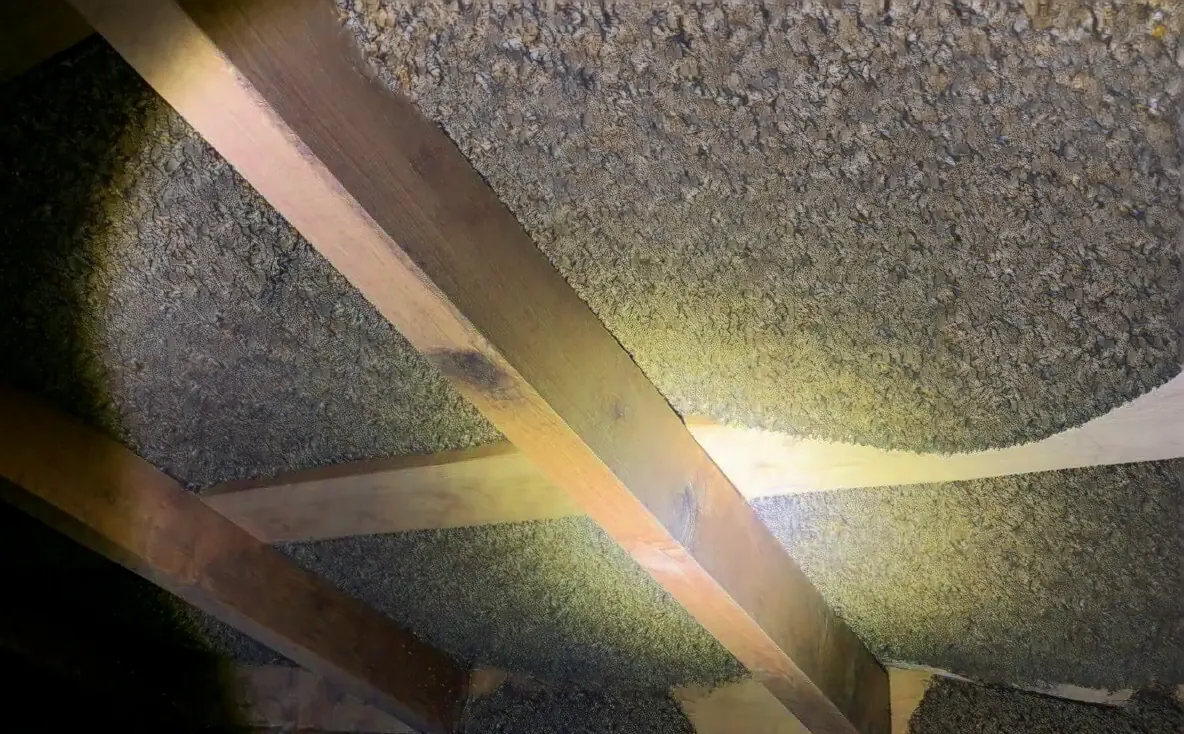
Vermiculite attic insulation
Vermiculite is a natural mineral that expands into light, pebbly granules when heated. It was sold as loose-fill attic insulation for decades, most famously under the Zonolite brand. For many years most of it came from a mine near Libby, Montana, where the vermiculite was contaminated with asbestos. The mine closed in 1990.
In Middle Tennessee, vermiculite tends to turn up in older homes, sometimes under newer fiberglass or blown-in insulation that was added on top. You might spot it:
- Between attic floor joists, often under newer insulation.
- Spilling out of gaps around light fixtures or attic hatches.
- Inside the hollow cores of concrete block walls.
Found vermiculite? Don’t disturb it. Don’t vacuum it with a household vacuum, don’t move boxes across it, and don’t let anyone run wires or add insulation until a professional has evaluated it.
Testing and removing vermiculite
Testing vermiculite is less straightforward than testing a ceiling or tile, because asbestos may be unevenly spread through it. Professionals use specialized lab methods and multiple samples. Because of this, the EPA’s guidance is to assume it may contain asbestos and manage it accordingly.
Removal is specialized work. Licensed contractors seal off the attic, keep it under negative air pressure, and vacuum the vermiculite out with HEPA-filtered industrial equipment straight into sealed containers. Afterward the attic is cleaned and can be re-insulated with modern material.
Typical cost for vermiculite removal from a Middle Tennessee attic is often in the $4,000–$15,000 range depending on attic size, depth of insulation, access and how much cleanup is needed. See the cost guide.
Pipe, boiler and duct insulation
Before about 1980, hot water pipes, steam pipes, boilers and furnace ducts were often wrapped in asbestos insulation. You’ll find it in basements, crawl spaces and mechanical rooms of older homes, especially in older Nashville neighborhoods and historic homes in Murfreesboro and Franklin. Common forms:
- Corrugated “air-cell” wrap: white or gray, looks like layered cardboard.
- Pre-formed pipe sections with a canvas or paper jacket, often with fitting insulation (“mud”) at elbows and joints.
- Boiler and furnace insulation: cement-like coating or block on old heating equipment.
- Duct tape and wrap: white or gray fabric-like tape at duct seams.
Pipe insulation that is crumbling, torn or “friable” (easily crushed by hand) is a higher risk, because it releases fibers easily. Never strip it off yourself.
Your options
- Repair or seal small damaged areas with approved wraps or encapsulants (done by a pro).
- Enclose intact insulation with a protective jacket.
- Remove it before replacing pipes, a furnace or a boiler, or when it’s badly damaged. Licensed crews often use glove bags, sealed plastic enclosures around each section of pipe, to remove it without contaminating the room.
Pipe insulation removal is often priced per linear foot, commonly about $20–$60 per foot with minimum job charges. HVAC contractors replacing an old furnace will usually ask for asbestos to be dealt with first.
Other insulation that can contain asbestos
Asbestos was also used in some old wall insulation, fireproofing sprayed on structural steel (mostly commercial), and in insulating board around fireplaces and wood stoves. If you’re opening walls in an older home, a pre-renovation inspection will catch these.
Insulation testing and removal near you
We connect homeowners with licensed insulation-abatement contractors in Murfreesboro, Smyrna, La Vergne, Nashville, Franklin and Brentwood. Call (615) 000-0000 or describe what you found in the form.